Curiosity: What the 49 Drill Holes in the MAHLI Collage Show
Added to NASA’s Photojournal on November 16, 2026, the collage brings together 49 drill holes documented by Curiosity through November. Each represents a Martian rock sample. The images were taken by the MAHLI camera, while instruments inside the rover analyze the composition of the powdered material. [1]
2026-11-16 · Redação ConverteArq
A Collage Made Over the Course of the Mission
On November 16, 2026, NASA added to its Photojournal a collage bringing together 49 drill holes documented by the Curiosity rover on Mars through November of that year. The image, identified as PIA26802, allows viewers to see together marks made in different rocks over the course of the rover’s exploration. [1]
The number 49 refers to the holes included in the visual record, and each mark corresponds to a rock sample collected on the Martian surface. NASA itself says each hole is 0.63 inches in diameter, equivalent to 16 millimeters: a small opening, but one linked to a stage of collection and analysis aboard the rover. [1]
The collage is credited to NASA/JPL-Caltech/MSSS. Its informational value lies in showing the drill sites side by side; on its own, however, the composition does not present the chemical results for the samples or explain what each one revealed. [1]
The Camera and the Analysis Serve Different Functions
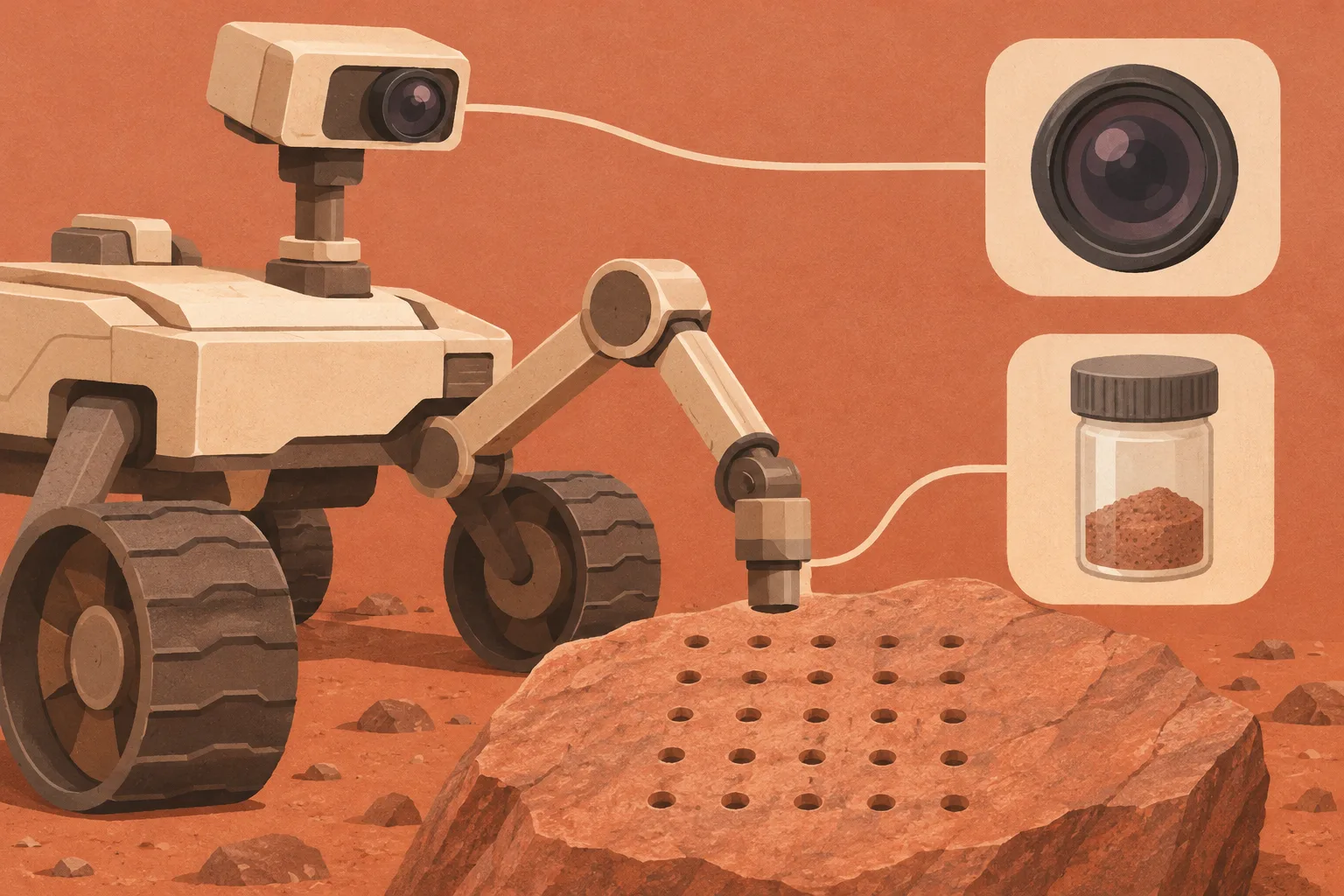
The images of the holes were taken by the Mars Hand Lens Imager, known as MAHLI. The camera is located at the end of Curiosity’s robotic arm, a position also occupied by the drill. MAHLI thus visually documents the marks, while drilling obtains material from the rock. [1]
After being powdered, the rock is deposited in instruments installed inside the rover, which analyze its composition. This distinction helps in interpreting the collage: it is a photographic record of the collection sites, not a direct visualization of the material’s composition or a laboratory analysis in image form. [1]
NASA says the MAHLI camera was built by Malin Space Science Systems in San Diego. The collage credit also identifies the involvement of NASA, JPL, Caltech and MSSS, but does not assign each entity a specific contribution to each hole pictured. [1]
What Can Be Concluded From the Record
The collage documents Curiosity’s drilling activity through November 2026 and offers a compact way to visualize 49 collections. On its own, it does not allow viewers to compare the composition of the rocks, determine why each site was chosen or establish the scientific significance of each sample. Those conclusions require analytical information that is not contained in the photograph alone. [1]
The institutional context provided by NASA is that the rover was built by the Jet Propulsion Laboratory (JPL), managed by Caltech in Pasadena, California. JPL leads the mission on behalf of NASA’s Science Mission Directorate, as part of the Mars Exploration Program. [1]
Separating documentation from interpretation avoids attributing more to the image than it shows: the 49 holes are visual evidence of collections represented in the collage; the composition of the samples is examined by onboard instruments. NASA’s page provides this operational context, but the data available for this report do not detail individual results from the 49 analyses. [1]
Context and analysis
From an editorial perspective, the collage’s main value lies in making visible a technical routine that can go unnoticed in accounts of planetary exploration: obtaining material from rock and observing the collection site are related actions, but they produce different kinds of information. The MAHLI photograph records the surface and the holes; composition analysis takes place in internal instruments. Distinguishing these stages helps readers avoid treating the image as though it contains the results of the chemical investigation on its own. [1]
It is also important to read the number precisely. The collage brings together 49 holes within a time frame extending through November 2026, according to NASA’s description. That total describes the content of that visual record, not necessarily all drilling operations the rover has ever performed or the number of scientific discoveries. The source used here does not support those extrapolations, so the report remains within the scope stated for the image. [1]
Sources and references
- NASA — US / tecnologia — A Collage Showing 49 Drill Holes Made by NASA’s Curiosity Mars Rover - NASA Science
2026-11-16 · 2026-11-17 · en