Perseverance investigates rocks rich in hydrated silica at Idubi, Mars
A NASA update reports that Perseverance is investigating light-toned rocks rich in hydrated silica at Idubi, in the Lac de Charmes region. SuperCam confirmed their composition and non-igneous origin, while the proximity science campaign seeks to better characterize the rocks and their context. [1]
2026-11-16 · Redação ConverteArq
What the data confirm
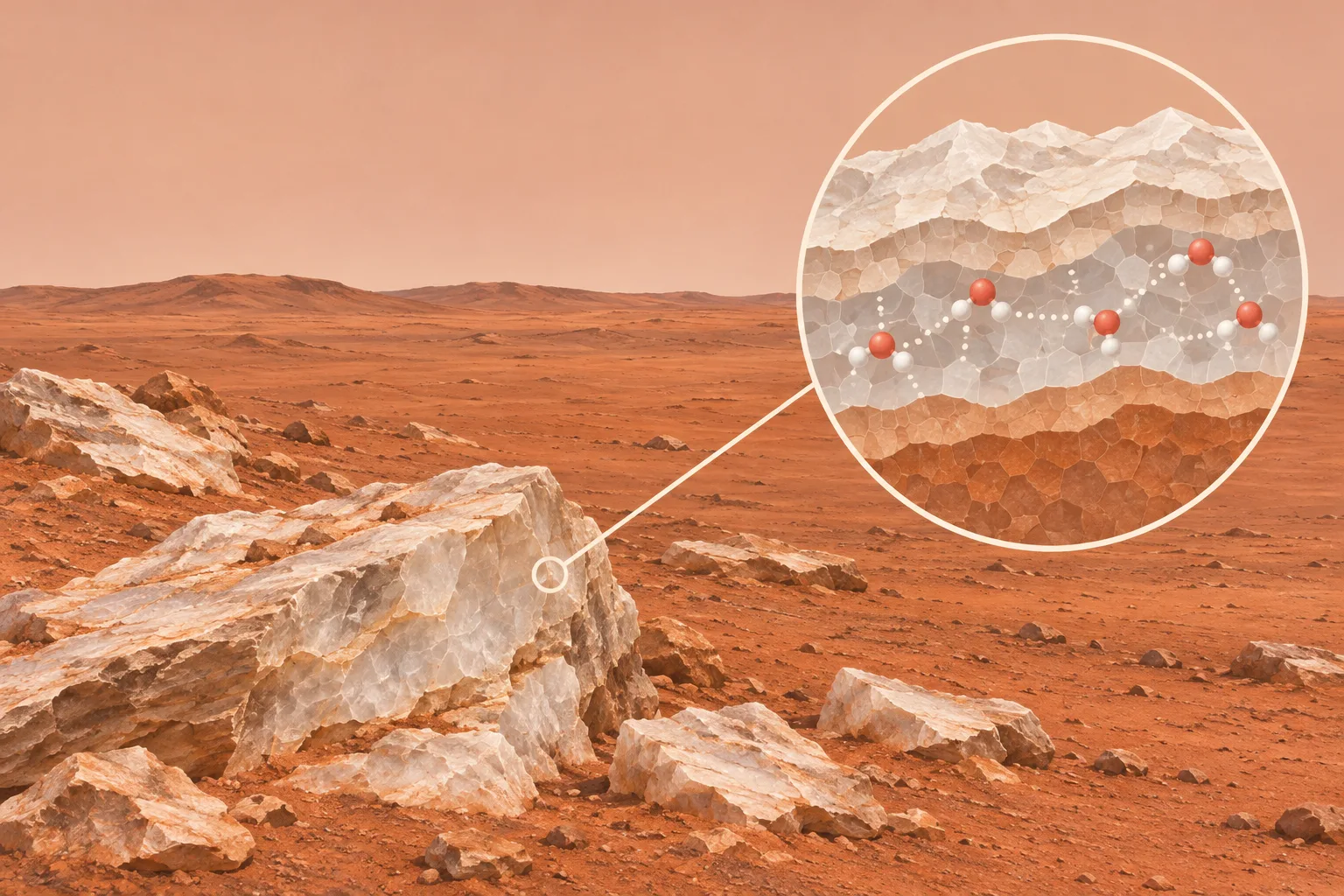
In an update published on November 16, 2026, NASA reported that the Perseverance rover was investigating Idubi, an area of exposed ancient Martian crust in the Lac de Charmes region, outside Jezero Crater. The site came into focus because of its light-toned rocks, whose composition was examined using newly received data from the SuperCam instrument. [NASA](https://science.nasa.gov/blog/perseverance-update-the-ghostly-rocks-of-idubi-bright-remnants-of-aqueous-systems-from-long-ago/) [1]
The analysis confirmed that the rocks are not igneous in origin and are rich in hydrated silica. This establishes aspects of their composition and rules out an origin related to the solidification of molten material, but does not by itself identify the specific process that formed the deposits. The update makes this distinction by treating the geological interpretation as part of the ongoing investigation. [NASA](https://science.nasa.gov/blog/perseverance-update-the-ghostly-rocks-of-idubi-bright-remnants-of-aqueous-systems-from-long-ago/) [1]
Why silica matters
On Earth, hydrated silica can form in different aqueous environments, including hydrothermal, pedogenic and groundwater systems. The presence of this material at Idubi therefore makes the rocks relevant to investigating the history of water on Mars; it does not by itself determine which of these environments, or another process, was involved at the Martian site. [NASA](https://science.nasa.gov/blog/perseverance-update-the-ghostly-rocks-of-idubi-bright-remnants-of-aqueous-systems-from-long-ago/) [1]
The update highlights that deposits of this kind are targets for understanding the planet’s hydrological history and that several of the aqueous environments mentioned could have been capable of supporting life. It also emphasizes the astrobiological value of hydrated silica because of its ability to preserve microfossils and raises the possibility that the remnants at Idubi could contain signs of ancient life. This possibility is a research question; the available excerpts do not confirm the discovery of biosignatures at Idubi. [NASA](https://science.nasa.gov/blog/perseverance-update-the-ghostly-rocks-of-idubi-bright-remnants-of-aqueous-systems-from-long-ago/) [1]
Scale and progress of the investigation
The update compares Idubi with silica-rich deposits previously found by Perseverance on Jezero’s inner rim. On that earlier occasion, the deposits were too small to use proximity analysis instruments and gather the high-resolution chemical and mineralogical data needed to constrain their origin and their potential to preserve biosignatures. The scale of the Idubi rocks is described as more promising for this type of study. [NASA](https://science.nasa.gov/blog/perseverance-update-the-ghostly-rocks-of-idubi-bright-remnants-of-aqueous-systems-from-long-ago/) [1]
According to NASA, a detailed proximity science campaign was underway. The update does not anticipate its results: it reports that the investigation continues, while the distinction between confirmed composition, a formation environment yet to be clarified, and any potential evidence of life remains central to interpreting the finding. [NASA](https://science.nasa.gov/blog/perseverance-update-the-ghostly-rocks-of-idubi-bright-remnants-of-aqueous-systems-from-long-ago/) [1]
The update’s captions identify two images taken on October 29, 2026: a light-toned, silica-rich rock in the Idubi area photographed by the left Mastcam-Z camera, and a close-up image of a silica-rich rock in the area captured by the SHERLOC WATSON camera. The available information does not establish whether the two images show the same rock. [NASA](https://science.nasa.gov/blog/perseverance-update-the-ghostly-rocks-of-idubi-bright-remnants-of-aqueous-systems-from-long-ago/) [1]
Context and analysis
Editorial analysis: the main scientific value reported lies in the combination of a now-confirmed composition and an investigative context that still needs to explain how the rocks formed. Hydrated silica makes it plausible to examine an ancient interaction with water, but the variety of terrestrial environments in which it can form prevents the composition from being treated as proof of a single geological history on Mars. [NASA](https://science.nasa.gov/blog/perseverance-update-the-ghostly-rocks-of-idubi-bright-remnants-of-aqueous-systems-from-long-ago/) [1]
The astrobiological significance also requires separating potential preservation from detection. Silica’s reported ability to preserve microfossils explains why the material attracts interest; the question of signs of life at Idubi indicates a possibility to investigate, not a confirmed result. For Brazilian readers, this distinction helps prevent the expression “promising rocks” from being understood as an announcement of ancient life on Mars. [NASA](https://science.nasa.gov/blog/perseverance-update-the-ghostly-rocks-of-idubi-bright-remnants-of-aqueous-systems-from-long-ago/) [1]