Radio frequency: what the number in MHz actually identifies
The number used to identify a radio station describes a property of its transmission. It is not the sound frequency of the music you hear.
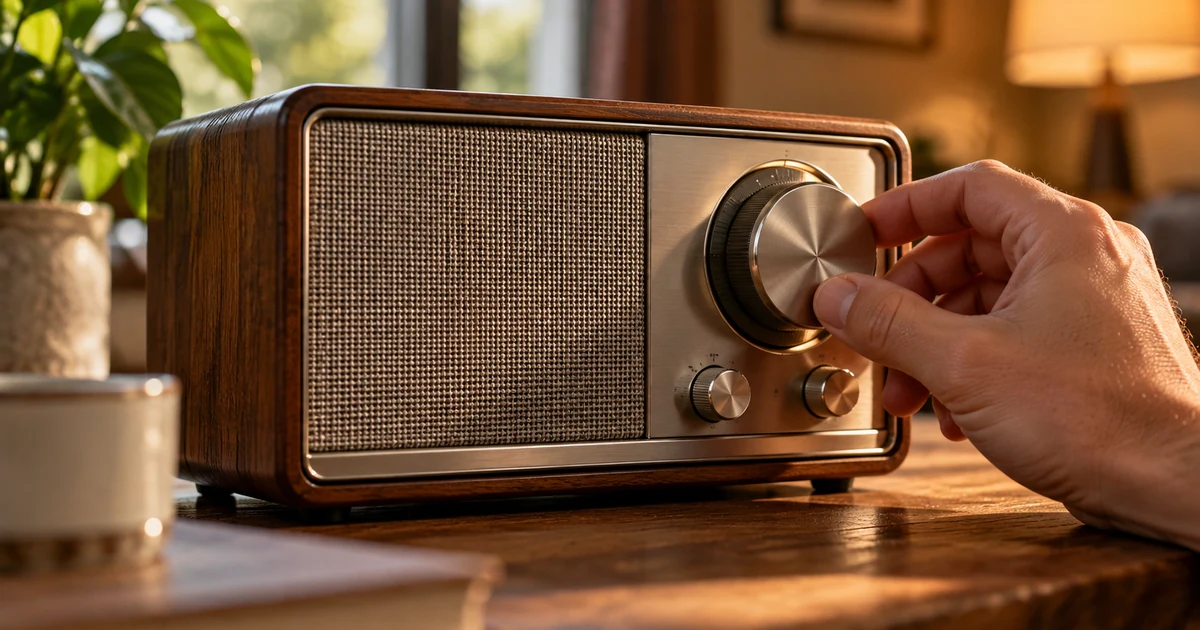
What the frequency describes
The Brazilian Ministry of Communications explains that a station’s frequency identifies the radio wave used to carry its signal. Frequency counts oscillations over time: one hertz (Hz) is one oscillation per second, and one megahertz (MHz) is one million hertz. The ministry gives 100.1 MHz as an example of a wave with 100.1 million oscillations per second.
That figure describes the carrier wave, not the pitch of a voice or a musical note in the programme. The explanation is about how the transmission is identified; it does not grant permission to broadcast or say which stations can be received at a particular address.
Transmission and programme are different layers
A useful way to separate the ideas is to ask two questions: which signal should the radio select, and what information does that signal carry? The tuning number helps identify the transmission. Music, speech and other programme content are carried by it.
Frequency assignments are organized to reduce the chance of interference among services and stations. Reception also depends on technical conditions such as transmitter power, station location and antenna characteristics. A frequency by itself is not a coverage map or a diagnosis of poor reception.
A fictional example, not a station listing
Suppose an explanatory example uses 98.7 MHz. That number refers to the transmission’s carrier wave; it does not tell you the musical pitch of a speaker’s voice. The example is fictional and does not identify a real broadcaster or indicate that a station is available in your area.
To check a real station, use information tied to the station and locality from an official source. Do not infer authorization, transmitter power or reception range from a number on a radio display.
Related topic
Official source reviewed
The official source was checked on October 12, 2026. Its explanation was summarized, not translated in full.
Frequently asked questions
Does 98.7 MHz tell me the pitch of a song or voice?
No. In this fictional example, MHz describes the carrier wave used for a transmission, not the audio pitch of the programme.
Does the same frequency identify the same station everywhere?
A number alone is not enough to identify a service across locations. Check the station and locality in an official source.
Does the tuning number show how far the signal reaches?
No. It is not a coverage map. Reception depends on technical conditions, including transmitter power, station location and antenna characteristics.
ConverteArq commentary
Familiar numbers can invite a quick but mistaken conclusion. Explaining the carrier wave separately from the sound makes the unit useful without suggesting it measures the music or voice.
We also keep the example explicitly fictional. A short conceptual example can clarify what MHz means, but it cannot answer which services operate in a place or predict reception there.