Technology and AI · Translation published October 17, 2026 · Portuguese original published October 11, 2026
Rural connectivity: how data can support farm decisions without promising higher yields
Editorial context: Brazil’s Ministry of Communications published an explanation of rural connectivity on October 6, 2026. This topic was not described as one of Google Trends’ top 30 groups.
Internet access can bring weather, market and service information closer to rural work. Its practical value depends on the data available and the task a producer needs to carry out. This guide separates connectivity, information and agricultural outcomes.
What the official publication says
On October 6, 2026, Brazil’s Ministry of Communications linked internet access in rural areas with information about weather, prices and services, as well as technologies such as sensors and precision agriculture. This article does not attribute a harvest increase to a particular device or present a productivity estimate as a guarantee for an individual farm. Connectivity, information and agronomic results are different things. The ministry’s publication supplies the context; the example and analysis below are educational, and ConverteArq did not conduct a field test.
Start with the decision that needs information
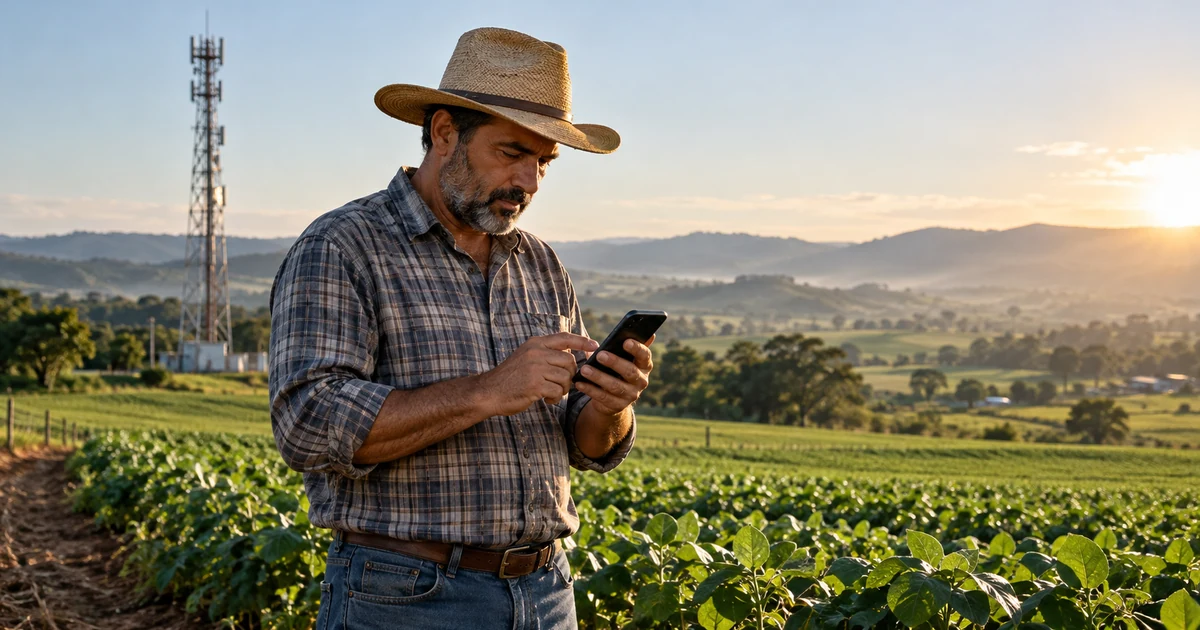
To assess a technology for farm work, first describe the decision: checking a forecast, recording an observation or monitoring a measurement. Then identify where the data comes from, how often it is updated and what happens when the connection is unavailable. This map can help prevent a purchase based only on a long feature list. It does not replace technical advice on crop management or a coverage survey for a property. The cover is an AI-generated illustration; it does not document a measured connection, productivity gain or proven causal link to a harvest.
A hypothetical farm record
Imagine a producer who wants to consult weather information and keep records of an activity. They could note the forecast source, the observation made on the property and the resulting decision, with a date for each entry. If the connection fails, the record should say that no update occurred instead of presenting old information as current. This fictional example does not recommend a farming practice or estimate yield. A real solution would require checking coverage, support, maintenance and fit with existing work. Access to a data point is only one step; interpreting its limits requires context.
Sources and verification
The Ministry of Communications published its explanation on October 6, 2026; it was checked for this translation on October 17. The ministry source provides context, not a field study by ConverteArq.
ConverteArq’s comment
Connectivity is most useful when it answers a concrete question in the daily routine. Explaining the link between rural technology and a specific task can be more informative than promising that an internet connection, sensor or app will raise output under every condition. Identifying the data source, update time and decision keeps the discussion precise and makes clear where local assessment or technical advice is still needed.
Continuity deserves as much attention as novelty. A tool that shows when information was last updated and acknowledges a missing update may be more useful for organizing work than an interface that always displays a number. This is an editorial view about information quality. We did not run an agricultural trial, compare network coverage or calculate a financial return; those claims would require their own evidence.