Science and Nobel Prizes · announcement on October 7, 2026 · The award was announced on October 7, 2026; the Royal Swedish Academy of Sciences source was checked October 19.
Chemistry Nobel 2026: mirror-image molecules and the challenge of controlling reactions
Henri B. Kagan and Kenso Soai received the 2026 Nobel Prize in Chemistry. Here is an accessible explanation of mirror-image molecular forms and why controlling reactions matters.
What the 2026 award recognizes
The Royal Swedish Academy of Sciences announced on October 7 that Henri B. Kagan and Kenso Soai would receive the 2026 Nobel Prize in Chemistry “for the discovery of non-linear effects and autocatalysis in asymmetric organic synthesis”. The Academy’s explanation connects their work to a long-standing question: how a reaction can produce an excess of one of two mirror-image molecular forms.
Kagan’s work in 1986 showed a way to obtain a greater excess of one form than chemists had considered possible. Soai later designed an autocatalytic reaction: a product helps catalyse its own formation. The Academy says a 1995 publication described the reaction’s potential and that a 2003 experiment formed only one of the two possible mirror-image products. The discoveries have helped chemists design reactions used in pharmaceutical manufacturing; the award does not announce a particular medicine.
A way to understand mirror-image forms
Some molecules come in forms that relate like a left hand and a right hand. They are called enantiomers. The two forms can interact differently with other molecules, including biological systems. The Academy uses amino acids as an accessible example: proteins in living organisms predominantly use one mirror-image form.
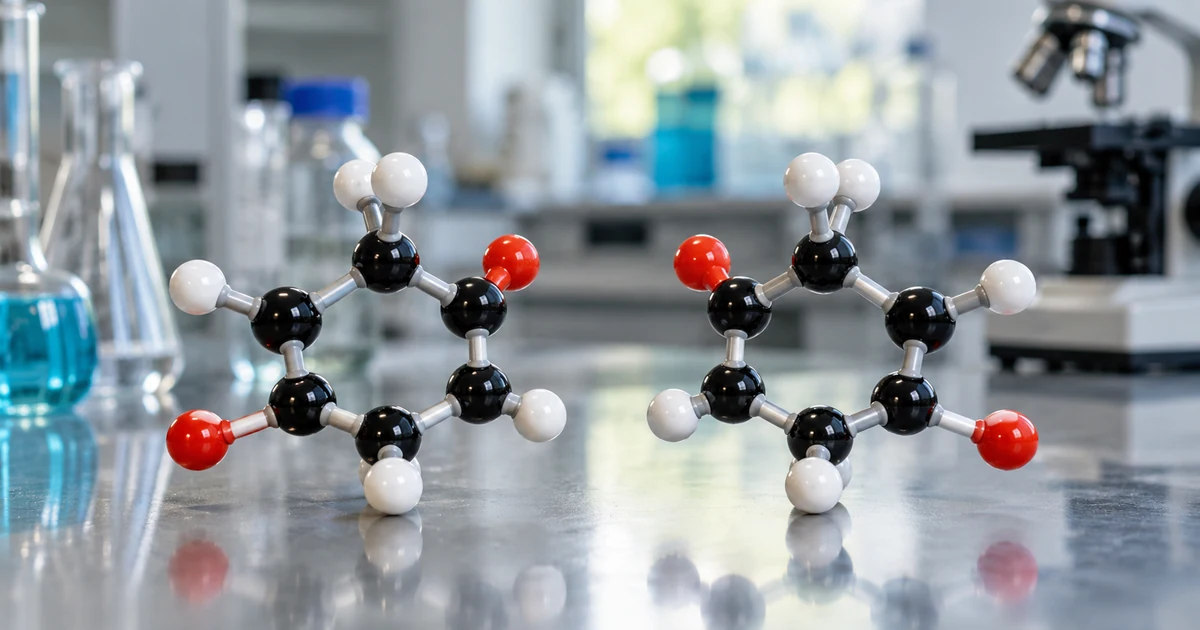
The scientific challenge is to guide a reaction toward a desired form rather than an even mixture. “Non-linear effects” and “autocatalysis” describe mechanisms that can amplify an initial imbalance. The cover is an AI-generated conceptual illustration of physical molecular models in mirrored orientations. It does not identify a molecule in the research or document a real laboratory setup.
What to look for in application claims
A discovery can matter without becoming a product that is ready for sale. When a report says that a finding “may help” or “opens a path”, look for the research question, the supporting evidence and the steps that remain before an application. Do not turn a possibility into a launch date or a claim about a specific treatment when the source provides neither.
A useful checklist asks: What scientific problem does the discovery address? What observation or experiment supports the explanation? Is the application demonstrated, proposed or still a possibility? Does the report distinguish scientific contribution from a commercial announcement?
Why this belongs in a technology blog
Our coverage follows how scientific ideas connect with instruments, methods and engineering decisions. That connection needs an explanation, not just a label. In this case, the useful question is what chemists can control in a reaction and how they observe that control.
When covering a prize, we avoid presenting it as validation of any current product that uses a similar term or operates in the same industry. The Nobel announcement concerns scientific contributions and their relevance to designing reactions; it is not an announcement that a new medicine or technology is now available.
Source and verification
The Royal Swedish Academy of Sciences published its announcement on October 7, 2026. The official source was checked October 19. The commentary above is editorial interpretation.
ConverteArq commentary
What interests us most is the difference between recognizing a problem and developing a way to act on it. For technology readers, that transition is more useful than a list of names and medals. It helps show why a change in method can have lasting consequences. Our editorial approach is to follow the evidence and explain the vocabulary while keeping the scale of the claim proportionate to what the source demonstrates.
Science can be connected to everyday life without shortcuts. Mentioning medicines as an example does not provide health advice or mean a specific treatment came from this announcement. Likewise, mentioning AI in technology coverage does not mean AI contributed to the discovery. We should describe a concrete connection or say when one has not been established.