Science and Nobel Prizes · announcement on October 6, 2026 · The award was announced on October 6, 2026; IceCube and UW–Madison CHTC sources were checked October 19.
Physics Nobel 2026: IceCube reveals the technology behind the discovery
The 2026 Nobel Prize in Physics recognized Francis Halzen’s contributions to IceCube and the discovery of high-energy astrophysical neutrinos. The story also involves sensors, data and computing.
Who received the prize and why
The IceCube collaboration reported that Francis Halzen received the 2026 Nobel Prize in Physics, announced on October 6, for decisive contributions to the IceCube Neutrino Observatory and the discovery of high-energy neutrinos of astrophysical origin. Neutrinos are particles; the focus here is the technology that makes it possible to search for rare signals. This article discusses the discovery using information from the institutions involved.
From detector to processing
IceCube uses Antarctic glacial ice as a detection medium, with optical sensors embedded in a volume of about one cubic kilometre. The University of Wisconsin–Madison Center for High Throughput Computing (CHTC) describes the role of simulations and distributed computing in processing the work. Tools including HTCondor and Pelican help distribute jobs and data across available resources. These are institutional descriptions, not measurements made by ConverteArq.
The CHTC account says that researchers use computing infrastructure to process observations and run simulations. A detector records signals; computational workflows help researchers distinguish rare events from background and interpret the resulting data. The award recognizes Halzen’s contributions and the astrophysical-neutrino discovery, not a standalone software product.
Three layers for reading a science report
To follow a scientific story, separate observation, data processing and interpretation. First ask what the instrument records. Next ask how researchers distinguish signals from the rest of the data. Then ask what conclusion the results support. This order helps prevent a device or software name from being mistaken for a complete explanation.
How to read the photograph
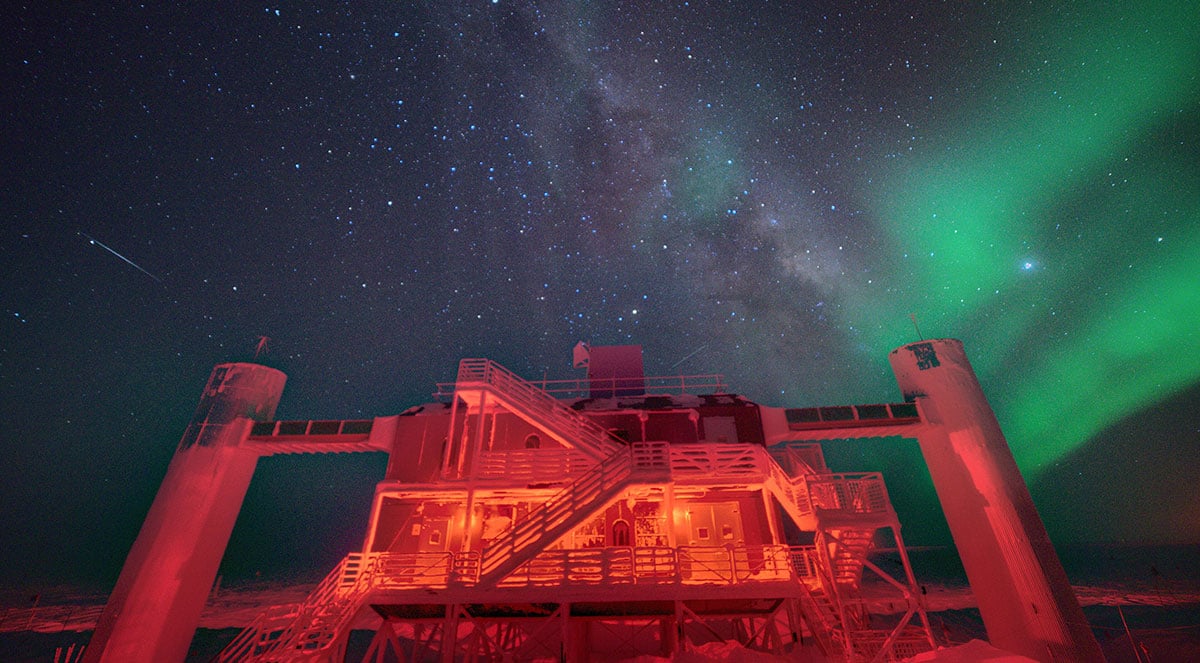
The photograph shows the laboratory at night. It does not show a neutrino trajectory or a visualization of detected events. The original source identifies photographer John Hardin and a CC BY 4.0 license; the image is reproduced without changes. A contextual photograph can orient readers as long as its caption does not claim to prove something it does not show.
Three questions
- Instrument: what was recorded, and by what mechanism?
- Data: what preparation, calibration or simulation is part of the workflow?
- Conclusion: what was observed, and what remains under study?
Sources and image license
The award was announced October 6, 2026. IceCube and CHTC pages were checked October 19. The commentary above is editorial analysis.
ConverteArq commentary
Our reading of the prize highlights a part of technology that product announcements often leave out: the infrastructure that supports a discovery. A science story becomes clearer when it connects instruments, data and computing work. That also changes the questions readers can ask. Instead of asking only which machine is faster, we can ask how the system makes analysis reliable and how others can examine the results.
The connection to AI needs precision. Computing in a research project does not justify attributing the discovery to a generative model. This article explains the institutional accounts of the computing role and adds an editorial view about infrastructure and evidence. Innovation also includes organizing resources, preserving traceability and building ways to observe phenomena that were difficult to study.