Payments and consumer information · Originally published October 11, 2026 · translated October 19, 2026
Pix Automático in salary accounts: the change is scheduled for July 2027
Brazil’s Central Bank has amended the Pix rules to allow Pix Automático transactions from salary accounts from July 1, 2027. The date is prospective: it does not mean the feature is already available in October 2026 or that every Pix operation is being opened to these accounts.
The rule has a future start date
A Central Bank update published on October 5, 2026 describes amendments to the Pix Regulation. Pix Automático in salary accounts, for recurring payments authorized by the customer, is scheduled to begin on July 1, 2027. The same update covers hybrid billing, where a document can present both a barcode and a Pix QR code, and procedures intended to prevent duplicate payment.
The salary-account change is not described here as active in October 2026. Nor does it remove every restriction on Pix transactions in salary accounts. The applicable rule is Resolution BCB 587; customers should confirm availability and conditions with their financial institution when the date approaches.
Authorization, bill and receipt are different records
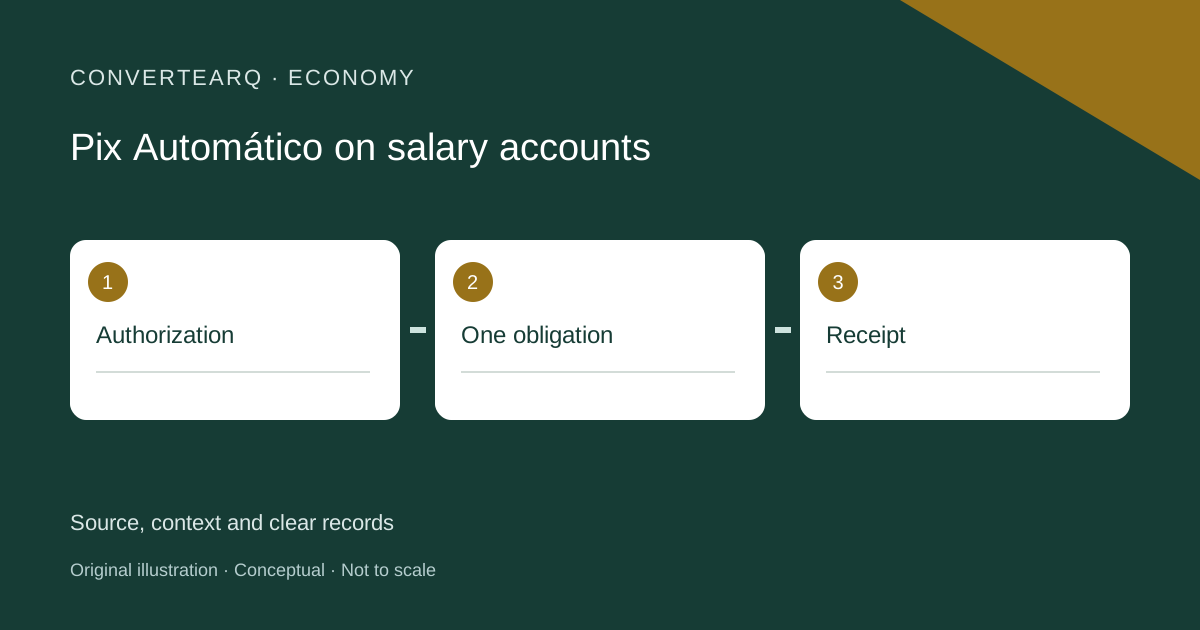
To understand a recurring payment, separate the customer’s authorization, the bill for an obligation and proof that the amount was settled. A document showing a barcode and a QR code may offer two ways to pay the same obligation; it does not automatically represent two debts. Check the recipient, amount and document reference through the institution’s official channels.
This example does not show a specific bank interface. Do not post account details or payment codes in blog comments. The diagram organizes the concepts and does not teach a financial transaction or replace the bank’s guidance.
A hypothetical way to keep track
Imagine someone saves a bill that has both a barcode and a QR code. Their record lists one obligation and, if payment has cleared, links the corresponding receipt. If the records disagree, the next step is to check with the institution through official channels, not to pay again simply because another option appears on the document.
This is an educational scenario, not an assessment of a real bill. To know when a feature will be available for a particular account, confirm implementation and eligibility with the responsible institution. An announced July 2027 date should not become an instruction to use the feature in 2026.
Source and verification
The Central Bank’s Resolution BCB 587 and related update were checked on October 19, 2026. The use of Pix Automático from salary accounts is scheduled for July 1, 2027.
ConverteArq commentary
The timeline is the central point: a regulatory change can be announced now and take effect later. Keeping July 2027 in the headline helps readers avoid expecting immediate access. The name Pix Automático also matters because a broad statement about Pix could overstate what the rule allows.
Hybrid billing raises a communication question too: identify the obligation before choosing how to pay it. Two payment options on one bill should not make a reader think that two payments are due. This is an organized way to read a document, not an individual account review or a substitute for the institution’s service channels.