F1 2026 power unit: more than an engine
This translation was prepared with AI assistance and checked against the cited sources. Editorial policy
Formula 1’s 2026 power unit combines a combustion engine with electrical and control components. This guide explains the terminology and the official figures without treating specifications as independent test results or predictions about a team.
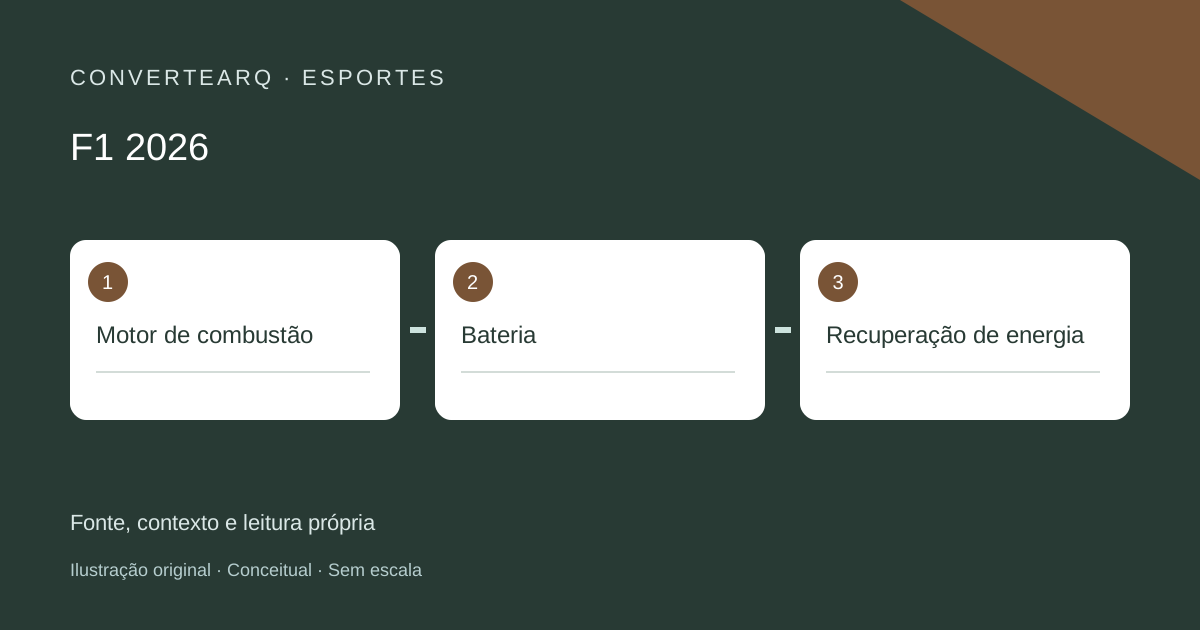
What the 2026 power unit includes
Formula 1’s January 14 explainer describes a system with a 1.6-litre turbocharged V6, turbocharger, battery (Energy Store), control electronics and MGU-K. The MGU-H, which recovered energy from exhaust heat in the previous architecture, is removed. The official guide gives the MGU-K a 350 kW figure, compared with 120 kW for the prior generation. Those are figures published by Formula 1, not measurements made by ConverteArq.
The term “power unit” helps distinguish the engine itself from the broader hybrid system. It does not mean that every component supplies power in the same way or for the same duration.
Power and energy answer different questions
Kilowatts describe a rate of energy transfer; energy describes an amount accumulated or used over time. A peak power figure alone therefore does not tell a reader how much energy is available through an entire lap, when it is deployed or how it is recovered. The official explainer describes recovery through the MGU-K, including under braking.
Formula 1 later reported proposed 2026 refinements that would allow up to 350 kW in key acceleration zones and limit deployment to 250 kW elsewhere on a lap. The April 20 article said the changes were planned from the Miami weekend and still required an FIA World Motor Sport Council vote. This proposed operational limit adds context to the headline specification; it is not a team comparison or a measured lap-time gain.
How to read a performance claim
A claim about a component specification and a claim about performance in a particular session are different kinds of evidence. To compare cars or results, a report would need a defined test, conditions, metric and traceable source. This guide contains no independent benchmark and describes no team’s performance.
The diagram is conceptual: it connects the engine, battery and energy recovery to explain vocabulary. It does not show physical placement, engineering drawings or measured flows. The example in the Portuguese original is hypothetical and does not describe a driver, race or result.
Sources and verification
Formula 1 published the power-unit explainer on January 14, 2026. Its regulation update dated April 20, 2026 describes the MGU-K limits planned from the Miami weekend. Both sources were checked October 17, 2026. The figures are attributed to Formula 1; ConverteArq did not test a car.
ConverteArq commentary
Our view is that “power unit” is a useful reminder that a modern racing car combines combustion and electrical systems. Explaining the parts helps readers ask what a number measures, when a limit applies and who reported it.
A specification should not be turned into a prediction of victory. Race classification needs its own confirmation; an architecture diagram explains a system, not an outcome. The original was published in October as a guide to a January explainer, so it is historical context rather than a new launch.